
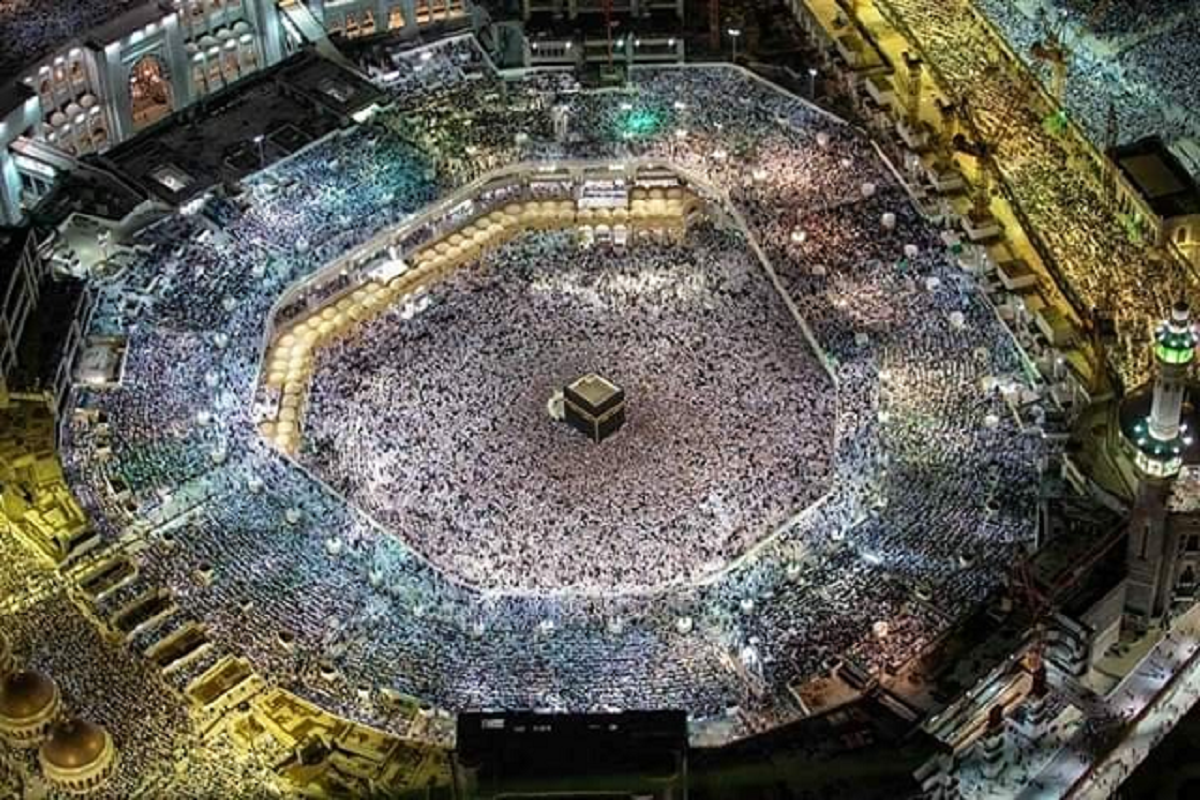
How to Perform Umrah: A Step-by-Step Guide
Umrah
Umrah is a blessed Sunnah pilgrimage, commonly known as the Minor Hajj. Muslims can perform Umrah throughout the year, except during the five days of Hajj (9th–13th Dhul Hijjah), when it is regarded as Makrooh Tahreemi to perform it. It offers a wonderful opportunity to seek Allah’s mercy, forgiveness, and countless spiritual rewards.
Virtues of Umrah
The Prophet ﷺ highlighted the immense rewards and blessings of performing Umrah. Some of its virtues include:
- One Umrah expiates the sins committed between it and the next Umrah. (Sahih al-Bukhari & Sahih Muslim)
- Performing Umrah during the month of Ramadan carries the reward of Hajj. In another narration, the Prophet ﷺ said it is equivalent to performing Hajj with me. (Sahih Muslim)
- The pilgrims of Hajj and Umrah are the honored guests of Allah. When they call upon Him, He answers them, and when they seek His forgiveness, He forgives them. (Ibn Majah)
Necessary Acts of Umrah
To complete Umrah correctly, the following acts are required:
Fard (Obligatory)
- Ihram – Entering the state of Ihram by wearing the prescribed clothing, making the intention (Niyyah), and reciting the Talbiyah.
- Tawaf – Performing seven circuits around the Holy Kaaba with the intention of Umrah.
Wajib (Necessary)
- Sa’i – Walking seven times between the hills of Safa and Marwah.
- Halq or Qasr – Shaving the head (Halq) or trimming the hair (Qasr) to complete the Umrah.
Note: A detailed explanation of each of these essential acts is provided in the following sections.
Departure
Before leaving for your Umrah journey, prepare yourself both spiritually and mentally.
- Offer two Rak’ahs of Nafl prayer at home before departure. After completing the prayer, thank Allah سبحانه وتعالى for granting you the opportunity and ability to undertake this blessed journey.
- Make sincere du’a and ask Allah to make your journey easy, safe, and full of blessings. Pray for protection from the whispers of Shaytan and the temptations of the nafs, and ask Him to accept your Umrah and enable you to spend your time in acts that earn His pleasure.
- Begin your journey with good character and devotion. Perform the five daily prayers on time, treat fellow travelers with kindness and respect, help those in need, avoid harming others, and keep yourself engaged in the remembrance of Allah, recitation of the Qur’an, learning, and beneficial deeds throughout your journey.
Ihram
Entering the state of Ihram is the first essential step of Umrah. Before crossing the Meeqat, prepare yourself as follows:
- Perform Ghusl (ritual bath) if possible; otherwise, perform Wudu. Men should then wear the two white, unstitched Ihram garments—one wrapped around the lower body and the other over the upper body. Applying perfume before making the intention of Ihram is permissible for men. Women should remain in their regular modest Islamic clothing, ensuring that the face remains uncovered.
- Offer two Rak’ahs of Nafl prayer with the intention of entering Ihram while your head is still covered. It is recommended to recite Surah Al-Kafirun in the first Rak’ah and Surah Al-Ikhlas in the second, although any verses from the Holy Qur’an may be recited if preferred.
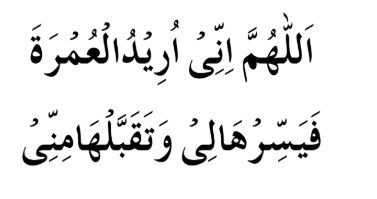
- After completing the two Rak’ahs, men should uncover their heads and remain seated on the prayer mat. Make the intention (Niyyah) for Umrah by reciting:
Transliteration:
Allahumma inni ureedul ‘umrata fayassirha li wa taqabbalha minni.
Translation:
“O Allah, I intend to perform Umrah. Make it easy for me and accept it from me.”
After making the intention, recite the following Talbiyah three times. The Talbiyah marks your official entry into the state of Ihram and should be recited frequently throughout your journey until you begin Tawaf.
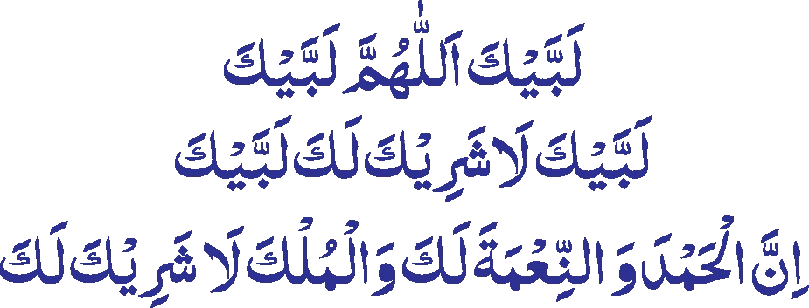
Hadith
Sahl ibn Sa’d (رضي الله عنه) narrated that the Messenger of Allah ﷺ said:
“When a Muslim recites the Talbiyah, every stone, tree, and all the ground to his right and left also recite the Talbiyah with him until the ends of the earth.” (Tirmidhi)
Men should recite the Talbiyah aloud, while women should recite it quietly. Afterward, send Durood (Salawat) upon the Prophet ﷺ and spend as much time as possible making sincere du’a.
Your Ihram officially begins when you have:
- Made the intention (Niyyah) for Umrah.
- Recited the Talbiyah.
Once you enter the state of Ihram, you must avoid all actions that are prohibited until your Umrah is completed.
Things Prohibited During Ihram
Once you enter the state of Ihram, certain actions become prohibited until your Umrah is completed. These include:
- Avoid intimate relations, including sexual intercourse, kissing, embracing with desire, or engaging in conversations of a sexual nature.
- Refrain from all sinful behavior, such as using obscene language, arguing, quarreling, or committing any act that Allah has forbidden.
- Do not hunt or harm animals, nor assist anyone in doing so. Even intentionally killing small creatures, such as lice, should be avoided.
- Do not use scented products, including perfume, fragrant oils, or anything with a noticeable fragrance on the body, clothing, food, or drink.
- Do not cut or shave hair from any part of the body, and avoid trimming your nails.
- Men must not wear stitched clothing specifically tailored to fit the body while in Ihram.
- Men should not wear footwear that covers the ankle bones or the top middle part of the feet.
- Men must keep their heads and faces uncovered throughout the state of Ihram.
- Women should not cover their faces. If non-mahram men are present, they may use a loose covering that does not touch the face.
- Treat others with kindness and respect. Do not harm or offend any Muslim, whether through words or actions.
Things Permissible During Ihram
While in the state of Ihram, the following actions are allowed:
- Using shade is permitted. You may use an umbrella or remain under the shade of a vehicle or building, provided it does not directly cover the head in a prohibited manner.
- Wearing essential accessories is allowed. Items such as a ring, eyeglasses, hearing aid, wristwatch, money belt, or document pouch may be used without any issue.
- Changing and washing Ihram garments is permissible. You may also bathe and wash your hair and body. However, avoid using scented soaps, shampoos, or other fragranced products.
- Accidental hair loss is excused. If a few hairs fall out naturally while washing or combing without intention, there is no sin.
- Covering the body while resting is allowed. You may use a blanket, quilt, or sleeping bag to cover your body and feet, but men should ensure that the head and face remain uncovered.
- Using a Miswak is permissible for maintaining oral hygiene while in Ihram.
- Carrying items on the head is allowed, as long as it does not involve covering the head in a prohibited way.
In Makkah Mukarramah
After entering the state of Ihram, keep yourself engaged in the remembrance of Allah, seek His forgiveness (Istighfar), and recite the Talbiyah frequently until you arrive in Makkah.
1. Enter Makkah with Humility
As you enter the blessed city of Makkah Mukarramah, do so with gratitude, humility, and reverence while continuing to recite the Talbiyah.
2. Proceed to Al-Masjid Al-Haram
After settling your belongings, make your way to Al-Masjid Al-Haram as soon as possible. Enter the Sacred Mosque with sincerity, humility, and a deep awareness of the greatness of Allah and the sanctity of this blessed place.
3. Dua When Entering the Masjid
Enter the mosque with your right foot first and recite the following supplication:
Arabic:
بِسْمِ اللّٰهِ وَالصَّلَاةُ وَالسَّلَامُ عَلَى رَسُولِ اللّٰهِ، اَللّٰهُمَّ افْتَحْ لِي أَبْوَابَ رَحْمَتِكَ
Transliteration:
Bismillaahi wassalaatu wassalaamu ‘alaa Rasoolillaah. Allaahummaftah lee abwaaba rahmatik.
Translation:
“In the name of Allah. May the peace and blessings of Allah be upon the Messenger of Allah. O Allah, open for me the doors of Your mercy.”
4. When You First See the Kaaba
Upon seeing the Holy Kaaba for the first time, recite the following three times:
Arabic:
اللّٰهُ أَكْبَرُ، لَا إِلٰهَ إِلَّا اللّٰهُ
Transliteration:
Allaahu Akbar. Laa ilaaha illallaah.
Translation:
“Allah is the Greatest. There is no deity worthy of worship except Allah.”
Then send Durood (Salawat) upon the Prophet ﷺ and make heartfelt du’a while facing the Kaaba.
Note: The first sight of the Kaaba is a special and blessed moment. It is an excellent opportunity to sincerely ask Allah for forgiveness, guidance, acceptance of your Umrah, steadfastness in faith, and success in this life and the Hereafter.
Important: A woman in the state of Hayd (menstruation) or Nifas (postnatal bleeding) should not enter Al-Masjid Al-Haram until she has become pure.
Tawaf
Tawaf is one of the Fard (obligatory) acts of Umrah. While performing Tawaf, remain engaged in the remembrance of Allah, recite du’a, and, if you wish, recite verses from the Holy Qur’an. Keep your voice low so that you do not disturb other pilgrims.
1. Begin at Al-Hajar Al-Aswad
Proceed to the corner of the Holy Kaaba where Al-Hajar Al-Aswad (the Black Stone) is located.
2. Locate the Black Stone
You can identify the location of Al-Hajar Al-Aswad by the green light positioned opposite its corner inside Al-Masjid Al-Haram. This marks the starting and ending point of each circuit of Tawaf.
3. Prepare for Tawaf
Before beginning, men should perform Idhtibaa (leaving the right shoulder uncovered) and stand facing the Kaaba so that Al-Hajar Al-Aswad is on the right side of the right shoulder. The floor is marked with a dark line indicating the correct starting position.
4. Make the Intention (Niyyah)
Stop reciting the Talbiyah and make the intention (Niyyah) to perform Tawaf.
5. Stand at the Starting Point
Move slightly to your right and stand on the marked line while facing the Kaaba. Ensure you are directly in line with Al-Hajar Al-Aswad before beginning.
6. Perform Istilam
Raise both hands toward Al-Hajar Al-Aswad and recite:
Arabic:
بِسْمِ اللَّهِ اللَّهُ أَكْبَرُ وَلِلَّهِ الْحَمْدُ
Transliteration:
Bismillaahi Allaahu Akbar walillaahil hamd.
Translation:
“In the name of Allah. Allah is the Greatest, and all praise belongs to Allah.”
7. Kiss or Gesture Toward the Black Stone
If possible, gently kiss Al-Hajar Al-Aswad without pushing or harming others. If you cannot reach it, touch it with your hand if possible, or simply raise your hands toward it and recite:
Arabic:
بِسْمِ اللَّهِ اللَّهُ أَكْبَرُ
Transliteration:
Bismillaahi Allaahu Akbar.
Translation:
“In the name of Allah. Allah is the Greatest.”
Then kiss your hands. This act is called Istilam and is repeated each time you complete a circuit.
8. Complete Seven Circuits
Begin walking counterclockwise, keeping the Kaaba on your left. Continue until you return to Al-Hajar Al-Aswad, where you perform Istilam again. This completes one circuit. Repeat the same process until you have completed seven circuits.
9. Pray Two Rak’ahs
After finishing the seventh circuit and performing the final Istilam, proceed to Maqam Ibrahim and offer two Rak’ahs of prayer. It is recommended to recite Surah Al-Kafirun in the first Rak’ah and Surah Al-Ikhlas in the second. After the prayer, spend time making sincere du’a.
Note: If there is no space near Maqam Ibrahim, you may offer these two Rak’ahs anywhere within Al-Masjid Al-Haram.
10. Drink Zamzam Water
Next, proceed to the Well of Zamzam. Face the direction of the Kaaba, drink Zamzam water with a sincere intention, and, if possible, pour some over your body while making du’a.
Hadith
Jabir (رضي الله عنه) narrated that the Messenger of Allah ﷺ said:
“The water of Zamzam is for whatever purpose it is drunk.” (Ibn Majah)
Drink Zamzam water with a sincere intention, asking Allah for whatever is beneficial for you in this world and the Hereafter.
11. Visit Multazam
After drinking Zamzam water, proceed to the Multazam (the area between the Black Stone and the door of the Kaaba). If possible, place your chest and cheeks against the wall of the Kaaba, raise your hands in supplication, and make heartfelt du’a, as this is a blessed place for prayers.
Note: If you prefer, you may visit the Multazam before drinking Zamzam water.
12. Perform Istilam Again
Return once more to Al-Hajar Al-Aswad and perform Istilam. This Istilam before beginning Sa’i is Mustahab (recommended).
Important Guidelines for Tawaf
Respect Other Pilgrims
Kissing Al-Hajar Al-Aswad is a Sunnah, but protecting the dignity and safety of fellow Muslims is an obligation. Never push, harm, or inconvenience others in an attempt to reach the Black Stone. If the area is crowded, simply raise your hand toward it, recite “Bismillaahi Allaahu Akbar,” and continue your Tawaf. Allah rewards sincere intentions.
Make Personal Du’as
There are no fixed du’as that must be recited during Tawaf. You may ask Allah for anything beneficial concerning both this life and the Hereafter.
Walk Around the Hateem
Since the Hateem is considered part of the Kaaba, your Tawaf must be performed outside the Hateem to ensure it is valid.
Ramal for Men
It is Sunnah for men to perform Ramal (walking briskly with short, quick steps) during the first three circuits of Tawaf.
Idhtibaa
Idhtibaa (leaving the right shoulder uncovered) is only for men and is practiced only during Tawaf. After completing all seven circuits, men should cover both shoulders again.
At Ar-Rukn Al-Yamani
When reaching Ar-Rukn Al-Yamani (the Yemeni Corner), it is Sunnah to touch it with the right hand if possible. There is no Sunnah of kissing it or gesturing toward it from a distance.
Dua Between Ar-Rukn Al-Yamani and Al-Hajar Al-Aswad
It is Sunnah to recite:
Arabic:
رَبَّنَا آتِنَا فِي الدُّنْيَا حَسَنَةً وَفِي الْآخِرَةِ حَسَنَةً وَقِنَا عَذَابَ النَّارِ
Transliteration:
Rabbanaa aatinaa fid-dunyaa hasanatan wa fil-aakhirati hasanatan wa qinaa ‘adhaaban-naar.
Translation:
“Our Lord, grant us goodness in this world and goodness in the Hereafter, and protect us from the punishment of the Fire.”
Keep the Kaaba on Your Left
Throughout Tawaf, always keep the Kaaba on your left side. Avoid turning your back, chest, or right side toward the Kaaba while completing the seven circuits.
Hadith
Ibn Abbas (رضي الله عنهما) narrated that the Messenger of Allah ﷺ said:
“One hundred and twenty mercies descend upon the Kaaba every day and night: sixty for those performing Tawaf, forty for those engaged in Salah, and twenty for those simply looking at the Kaaba.” (Bayhaqi)
This hadith highlights the immense blessings of worship within Al-Masjid Al-Haram, especially the great reward for performing Tawaf around the Holy Kaaba.
Hadith
Ibn Umar (رضي الله عنه) narrated that he heard the Messenger of Allah ﷺ say:
“Touching Al-Hajar Al-Aswad removes sins. Whoever performs Tawaf correctly, according to its prescribed manner, receives a reward similar to freeing a slave. Every step taken during Tawaf removes one sin and earns one good deed.” (Tirmidhi)
Sa’i
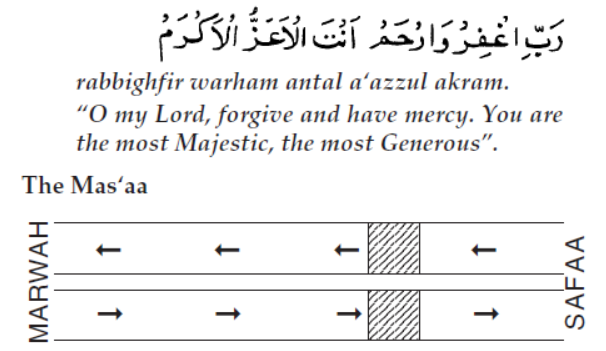
Sa’i is one of the Wajib (necessary) acts of Umrah. It consists of walking seven times between the hills of Safa and Marwah, following the Sunnah of Prophet Ibrahim (AS) and Hajar (AS).
1. Proceed to Safa
After performing Istilam, walk towards Safa, following the direction indicated by the green lights inside Al-Masjid Al-Haram.
2. Make the Intention
Climb Safa until you reach a point from where the Kaaba is visible. Face the Kaaba and make the Niyyah (intention) for Sa’i.
3. Praise Allah
Raise your hands as you would while making du’a and recite the following three times:
Arabic:
اللَّهُ أَكْبَرُ، لَا إِلٰهَ إِلَّا اللَّهُ
Transliteration:
Allaahu Akbar. Laa ilaaha illallaah.
Translation:
“Allah is the Greatest. There is no deity worthy of worship except Allah.”
4. Make Du’a
Recite Durood (Salawat) upon the Prophet ﷺ and make sincere du’a for yourself, your family, and the entire Ummah. Spend a few moments in supplication, as this is one of the blessed places where du’a is accepted.
5. Walk Towards Marwah
Begin walking from Safa to Marwah at a normal pace while remembering Allah and making du’a throughout the journey.
6. Between the Green Markers
When you reach the green lights, men should increase their pace and jog lightly until they reach the second set of green lights. Women should continue walking at their normal pace throughout.
7. At Marwah
Upon reaching Marwah, climb to a point facing the direction of the Kaaba and repeat the same remembrance and du’a performed at Safa.
Note: The Kaaba is not directly visible from Marwah today, so simply face its direction while making du’a.
8. Continue the Remaining Rounds
Walk back from Marwah to Safa in the same manner. This completes the second round. Continue until you complete seven rounds, ending your final round at Marwah.
9. Offer Two Rak’ahs (Recommended)
After completing Sa’i, it is Mustahab (recommended) to offer two Rak’ahs of Nafl prayer in Al-Masjid Al-Haram, if possible.
Important Note
There are no fixed du’as that must be recited during Sa’i. You may remember Allah and make any sincere supplications for your needs in this world and the Hereafter.
However, it is Sunnah to recite the prescribed supplications and remembrance mentioned in the authentic narrations while performing Sa’i.
Halq or Qasr
After completing Sa’i, the final step of Umrah is Halq (shaving the head) or Qasr (trimming the hair).
For Men
Men should either shave the entire head (Halq) or trim the hair (Qasr) evenly from all parts of the head. If choosing to trim, at least one inch (approximately 2.5 cm) should be cut from the hair. Shaving the head is considered more virtuous than trimming.
For Women
Women should trim slightly more than one inch from the end of their hair (or braid), ensuring only a small portion is cut.
Completion of Umrah
Once the hair has been shaved or trimmed, the rites of Umrah are complete. At this point, you leave the state of Ihram, and all the restrictions associated with Ihram are lifted.
May Allah accept your Umrah, forgive your sins, and bless you with His mercy, guidance, and countless rewards. Ameen.
Hadith
Yahya ibn Husayn reported from his grandfather that during the Farewell Hajj, the Messenger of Allah ﷺ supplicated three times for those who shaved their heads and once for those who trimmed their hair. (Sahih Muslim)
This Hadith highlights the greater virtue of Halq (shaving the head), while also confirming that Qasr (trimming the hair) is a valid way to complete Umrah.
WHILE IN MAKKAH MUKARRAMAH
1. You should remain busy in Salaat, du‘aa and recitation of the holy Qur’aan. You should complete the recitation of the holy Qur’aan at least once.
2. Perform each and every fardh Salaat with congregation in Al Masjidul Haraam. One such Salaat is equal to two million and five hundred thousand Salaat performed elsewhere.
3. Perform virtuous deeds as much as you can because every virtuous act in Makkah is equivalent to one hundred thousand virtuous acts. The holy Prophet sallallahu alayhi wasallam said, “Besides Makkah there is no city on the surface of the earth where Allah multiplies one virtue by a hundred thousand times”.
4. You should avoid all prohibited and execrable acts and things. Hadhrat ‘Umar and Hadhrat Ibne Abbaas radhiyallahu anhum said, “I would much rather prefer to commit seventy sins at Rukyah than to commit one sin in Makkah”.
NOTE: Rukyah is a place outside Makkah.
5. Perform as many tawaaf as possible because a nafl tawaaf is superior to a nafl Salaat.
NOTE: The offering of two raka‘at at Maqaami Ibraaheem is essential even after nafl tawaaf.
6. Perform Salaat in the Hateem whenever you have the chance.